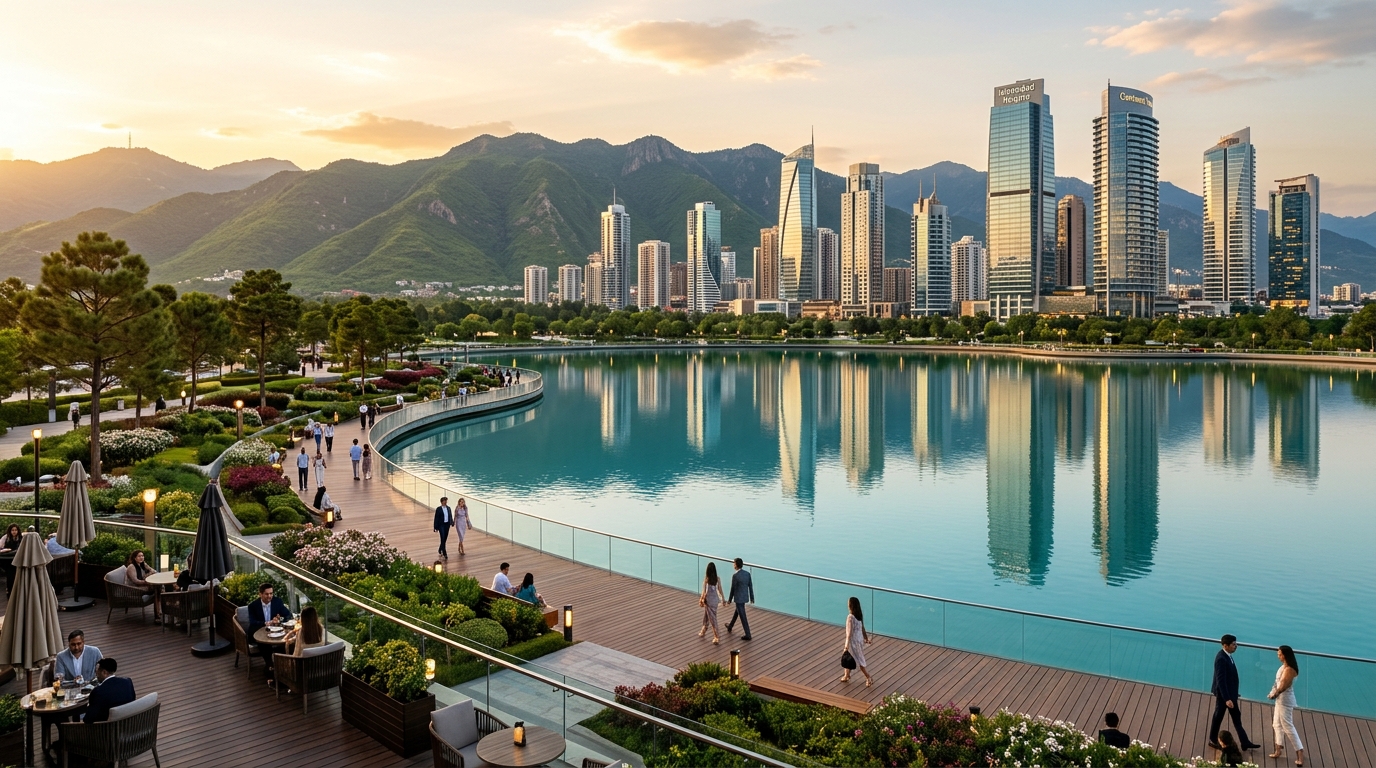
1. The Central Park Concept: Heart of the District
In New York's original Manhattan, Frederick Law Olmsted's 1858 Central Park design was a deliberate counterweight to the density of a planned skyscraper borough — a permanent lung of greenery that would define real estate values around its perimeter for over 150 years. Islamabad's Manhattan District borrows this foundational urban planning principle.
The Central Park and lake are positioned at the geographic heart of the 1,000-acre site — not at the periphery — so that the maximum number of tower plots face the park. This maximizes the number of units with direct park and lake views, creating a market-defined hierarchy of real estate value across the district.
Core Design Principles
- Centrality: Park positioned at the district's centroid so towers on all four sides have park-facing facades — maximizing view corridors and minimizing dead-end streets.
- Nullah Integration: Three seasonal Margalla Hills streams are channeled into and through the lake system — creating a naturalistic water body rather than a purely engineered reservoir.
- Active + Passive Zones: Active recreational areas (jogging tracks, cycle paths, outdoor fitness, children's play) on the western edge; passive contemplative zones (botanical gardens, reading lawns, bird habitat) on the quieter northern edge adjacent to Margalla Hills.
- Waterfront Promenade: A 3–4 km boardwalk promenade encircling the lake — accessible to all district tower residents and serving as the district's primary social spine.
2. Lake Engineering: Hydrology, Fill Sources & Flood Management
The planned artificial lake serves a dual function: amenity value (waterfront real estate premium) and stormwater management (Islamabad's urban flooding risk from Margalla Hills runoff during monsoon). The engineering design integrates both functions:
🌧️ Monsoon Retention Basin
Islamabad receives 900–1,100mm annual rainfall, concentrated in the July–September monsoon. Margalla Hills nullahs historically flash-flood the piedmont. The lake's primary engineering role is as a flood retention basin — capturing peak monsoon flows before they can cause damage to the tower district downstream.
💧 Water Fill Sources
Three fill sources are planned: (1) Seasonal nullah diversion during monsoon; (2) Treated greywater recycling from district towers via a centralized water recycling plant; (3) Emergency Rawal Dam pumped supply during drought periods — maintaining minimum aesthetic water depth year-round.
🐟 Ecological Linings
Lake bed construction will use geomembrane liners with engineered substrate layers to support aquatic vegetation and fish habitat — creating a biologically active water body that provides natural water purification, wildlife habitat, and eliminates stagnant water mosquito risk.
⛵ Recreational Water Use
Electric gondolas, kayaking lanes, pedal boats, and a floating restaurant platform are among the recreational elements proposed for the lake — revenue-generating uses that also justify the higher development and maintenance costs of the water body.
3. Islamabad's Central Park vs. New York's Central Park
| Feature | New York Central Park | Islamabad Manhattan District Park |
|---|---|---|
| Total Area | 843 acres | ~150–250 acres (est.) |
| Year Established | 1858 | Planned 2027–2029 |
| Surrounding District | 22.8 sq.mi borough | 1,000-acre Manhattan District |
| Water Feature | The Reservoir (106 acres) | Artificial lake (nullah-fed) |
| Peak Premium Generated | 40–80% above city average | 25–40% projected (park-facing) |
| Designer / Concept | Frederick Law Olmsted, 1858 | To be determined (international tender) |
| Climate Context | Humid continental (NYC) | Semi-arid Himalayan piedmont (ISB) |
4. Real Estate Price Impact of the Central Park & Lake
The waterfront and park-view premium is one of the most consistently documented phenomena in global urban real estate economics. Multiple international datasets confirm the pattern:
Global Waterfront & Park Premium Benchmarks
- Marina Bay, Singapore: Park/waterfront units at Marina Bay Sands and South Beach command 35–55% premium over equivalent non-view units in the same district.
- Hudson Yards, New York: Units facing the Hudson Park + Boulevard at Hudson Yards sell at 30–45% above non-park Hudson Yards units of similar specification.
- The Address Downtown, Dubai: Burj Khalifa and Dubai Fountain-facing units sell at 40–60% above equivalent units in the same towers facing the highway side.
- Projected Islamabad: Based on the above benchmarks, park and lake-facing units in Manhattan District towers are conservatively projected to carry a 25–40% premium at the ready-property stage — assuming the park is delivered before tower sales peak.
5. Ecological Benefits: Urban Heat Island Mitigation & Biodiversity
Beyond amenity value, the Central Park and lake serve critical ecological functions in Islamabad's urban microclimate, which is increasingly affected by urban heat island intensification:
🌡️ Urban Heat Island Mitigation
A 150–250 acre park with a lake can reduce local ambient temperatures by 2–4°C within a 500m radius. Given Islamabad's summer peak temperatures of 38–42°C, this cooling effect reduces tower HVAC loads by an estimated 8–15% for park-adjacent buildings — a quantifiable operational cost saving.
🦅 Migratory Bird Habitat
Islamabad sits on the Central Asian Flyway — one of the world's major migratory bird routes. A large urban lake with naturalistic edges will attract wintering waterfowl, wading birds, and raptors, creating a unique biodiversity corridor between Margalla Hills and the urban lake that enhances the district's ecological credentials.
💨 Air Quality & Carbon
200 acres of urban forest and riparian vegetation (estimated 40,000+ mature trees) would sequester approximately 800–1,200 tonnes of CO₂ annually and generate measurable PM2.5 particulate absorption — critical for a district of supertall towers generating significant vehicular traffic.
🌊 Groundwater Recharge
Pervious park surfaces and engineered lake infiltration systems will recharge Islamabad's increasingly stressed Rawal Dam aquifer — a critical co-benefit given the water supply demands of a district with 50+ supertall towers and potentially 100,000+ daily users.