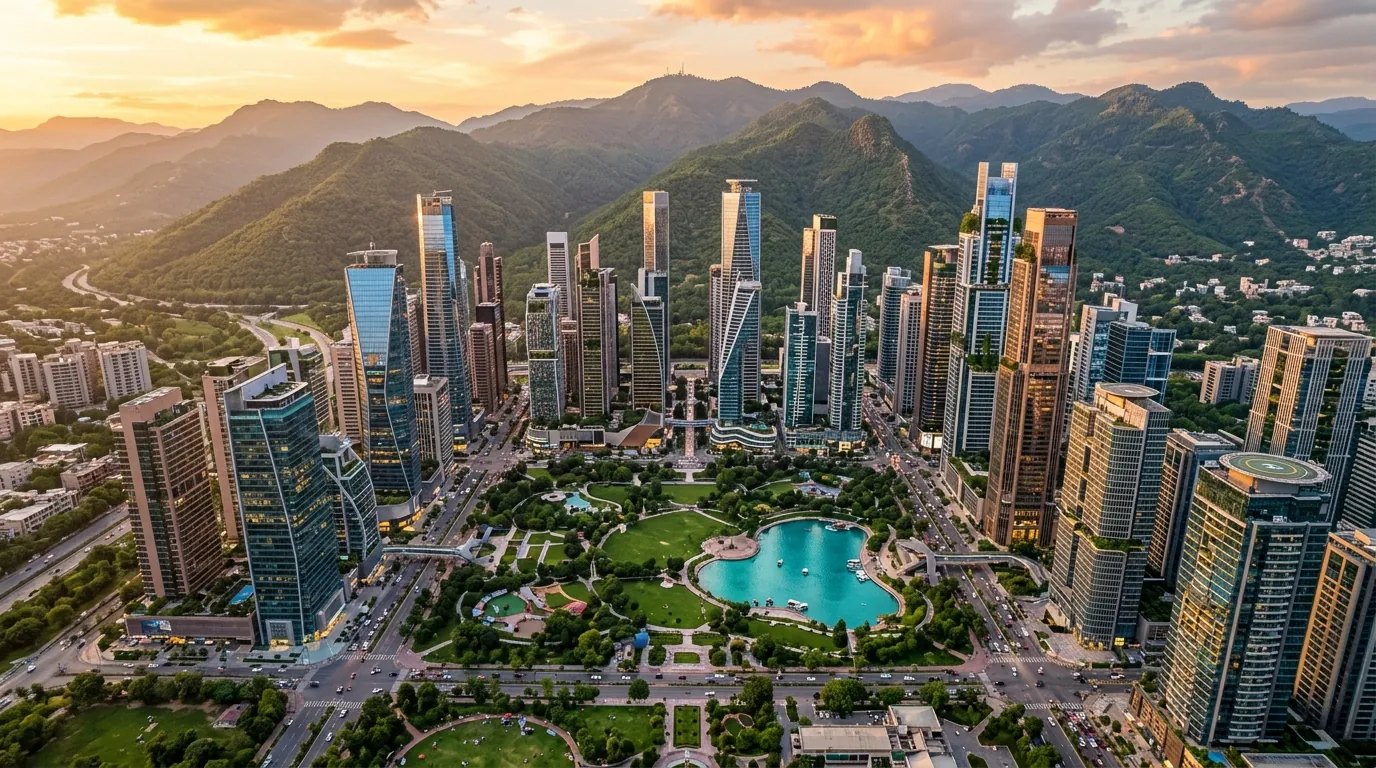
1. Power Grid Requirements: 220 kV Infrastructure
The existing Islamabad electricity distribution infrastructure operates primarily at 11 kV and 33 kV distribution voltage levels — adequate for residential sectors but wholly insufficient for a district of 50+ supertall towers. Each 50-storey mixed-use tower with a 600,000 sq.ft GLA requires approximately 36–48 MVA of installed transformer capacity.
Power Infrastructure Roadmap
- 220 kV Grid Substations (x3): Minimum three 220/33 kV grid substations totaling 2,500 MVA installed capacity — sourced from NTDC's national transmission system.
- Underground 33 kV Ring Main: A looped underground 33 kV distribution ring encircling the district, ensuring N-1 redundancy (no single cable failure can cause district-wide blackout).
- Tower-Level 11 kV Step-Down: Each tower plot's individual 11 kV substation and transformer vault to be constructed by the developer as part of the concession obligation.
- Renewable Integration: Mandatory solar PV installation on all rooftops and podium surfaces (minimum 20% of peak demand self-generation) — potentially generating 400–500 MW of on-site renewable capacity at full build-out.
- IESCO Coordination: The Islamabad Electric Supply Company (IESCO) must be engaged at the master plan stage to commission the 220 kV transmission line extension from the nearest NTDC point.
2. Water Supply: Rawal Dam Augmentation & Recycling
Islamabad's existing water supply draws primarily from Rawal Dam (22 MGD capacity) and Simly Dam (25 MGD), supplemented by tube wells. The CDA Water Management Directorate's total supply is approximately 47 MGD serving a population of 2+ million — already under stress during summer peak demand.
🏗️ New Dedicated Trunk Main
A new 600mm–900mm diameter pressurized water trunk main from the CDA distribution system to the Manhattan District boundary — capable of delivering 15–20 MGD of potable water for tower occupancy, fire suppression, and park irrigation.
🔄 Greywater Recycling Plant
A centralized 10–15 MGD greywater recycling facility within the district perimeter, treating toilet and kitchen wastewater to tertiary standard for toilet flushing, park irrigation, lake top-up, and podium cooling tower make-up water.
💧 Rooftop Rainwater Harvesting
Mandatory rooftop rainwater harvesting on all towers with a minimum 100,000-litre cistern per tower — capturing Islamabad's 900mm+ annual rainfall for non-potable use and reducing peak demand on the CDA main network.
🚰 High-Pressure Booster Stations
Three district-level booster pump stations to maintain adequate water pressure at 600ft+ heights — standard city water pressure (3–4 bar) is insufficient above 150ft, requiring in-building booster systems supplemented by district pressure zones.
3. District Cooling: The Smart HVAC Solution for Supertalls
District Cooling (DC) is the most energy-efficient HVAC solution for high-density supertall districts — replacing 50+ individual tower chiller plants with 2–3 centralized District Cooling Plants (DCPs) that distribute chilled water via an underground pipe network.
| Parameter | Individual Tower HVAC | District Cooling (DCP) |
|---|---|---|
| Energy Efficiency | COP 3.5–4.5 (per tower) | COP 5.5–7.0 (centralized) |
| Energy Consumption | 100% (baseline) | 35–50% reduction |
| Rooftop Space Used | Large (individual chillers) | None (centralized plant) |
| Maintenance | Per-tower (50+ systems) | Centralized (2–3 plants) |
| Night Thermal Storage | Not cost-effective per tower | Ice thermal storage — cheap off-peak power |
| Global References | — | Dubai Business Bay, Marina Bay Singapore |
4. Sewage Treatment & Stormwater Drainage
A district generating 15–20 MGD of potable water consumption will produce approximately 12–16 MGD of wastewater. Islamabad's existing sewage system (partially combined with stormwater, discharging into Shah Allah Ditta nullahs) is wholly inadequate for this load.
Required Sewage Infrastructure
- Dedicated District Sewage Collector Network: A 100% separate sanitary sewer system (gravity + pumped) collecting all tower wastewater to a central point — preventing any cross-contamination with stormwater or existing Islamabad mains.
- 15 MGD Wastewater Treatment Plant (WTP): A tertiary-standard activated sludge WTP within the district boundary, treating 100% of sewage to recycling-grade effluent for greywater reuse — zero discharge to natural water bodies.
- Stormwater Detention System: Underground stormwater detention tanks (minimum 50,000 m³ combined capacity) to capture peak monsoon runoff from 1,000 acres of hardstand — preventing flash flooding in downstream Islamabad sectors.
- Nullah Culverting: Three seasonal nullahs crossing the site must be hydraulically culverted under roads and paved areas — sized for the 1-in-100-year peak flow event per NESPAK hydraulic standards.
5. Telecommunications & Smart District Infrastructure
📡 5G-Ready Fibre Backbone
A 1,000-acre district requires a minimum 96-core underground single-mode optical fibre backbone connecting all plot boundaries — capable of supporting multi-operator 5G small cell networks, building automation systems, and smart traffic management.
🏢 In-Building DAS Networks
All towers must install Distributed Antenna Systems (DAS) for indoor 4G/5G coverage — supertall buildings create significant RF shielding. PTA compliance requires full indoor coverage certification before Occupancy Certificate issuance.
🌐 District Operations Centre
A centralized District Operations Centre (DOC) integrating CCTV (Islamabad Safe City integration), district cooling controls, utilities monitoring (SCADA for power, water, sewage), and emergency response coordination — operated by the Ministry of Interior's facility management arm.
🔋 EV Charging Infrastructure
DC fast-charging stations at minimum 10% of all basement parking bays (estimated 50,000+ total parking spaces at full build-out) — mandatory under Pakistan's EV Policy 2025. Managed by the district's smart parking operator under a revenue-sharing concession.