1. Islamabad's Zone Classification System
Islamabad's land is divided into four zones under the CDA Ordinance 1960 and subsequent gazette notifications, each with distinct development permissions:
| Zone | Description | Development Permitted | Relevant Authority |
|---|---|---|---|
| Zone-1 | Planned residential & commercial sectors | Full CDA-regulated development | CDA |
| Zone-2 | Rural/village areas within ICT | Limited rural development | DC Office ICT |
| Zone-3 | Margalla Hills National Park (Protected Forest) | No construction permitted | Supreme Court / Ministry of Climate Change |
| Zone-4 | Government land buffer / transitional zone | Limited development with federal approval | Ministry of Interior / CDA |
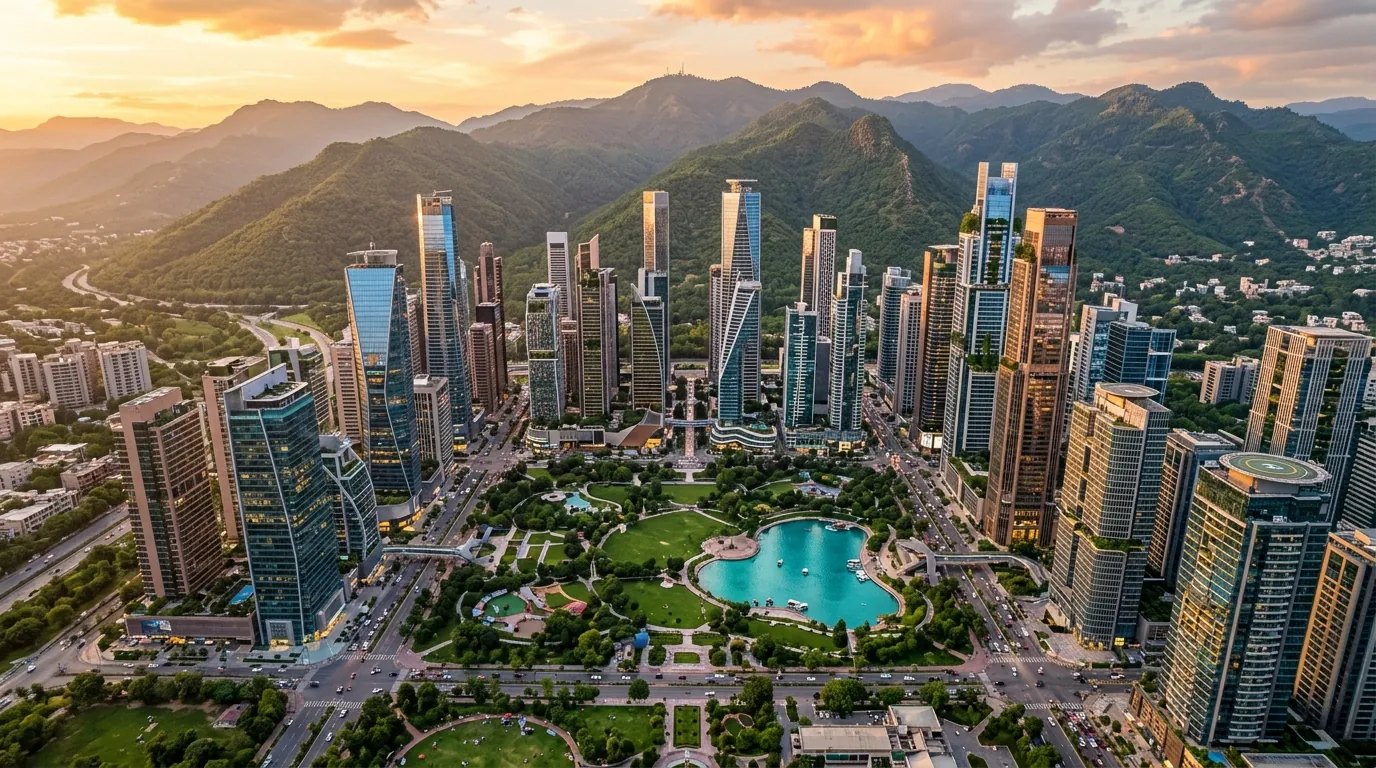
The Manhattan District's 1,000 acres fall at the Zone-3/Zone-4 interface — this boundary ambiguity is the core legal issue. The government classifies the site as Zone-4 government land; environmental petitioners argue portions fall within the notified Zone-3 boundary.
2. Key Supreme Court Orders on Margalla Hills Protection
Suo Motu Case No. 16/2009 — Landmark Forest Protection
The Supreme Court took suo motu notice of large-scale unauthorized construction within Margalla Hills boundaries. The court ordered demolition of encroachments, a ban on new commercial development within the protected zone, and mandated a fresh boundary survey by a joint committee of Survey of Pakistan and NESPAK. This remains the foundational precedent.
Green Islamabad Order 2017 — Encroachment Removal
The court ordered removal of encroachments on forest land, green areas, and parks across Islamabad — including on Margalla Hills foothills. CDA was directed to plant 100,000 trees on vacant land adjacent to the protected zone. This order directly affects the transition zone where the Manhattan District is planned.
Ongoing Islamabad Master Plan Cases (2024)
Multiple environmental petitions are currently before the Supreme Court and Islamabad High Court challenging CDA's revised Master Plan that reclassified portions of Zone-3 transitional land as developable. These active cases create direct legal risk for the Manhattan District if the site boundary is not demonstrably outside Zone-3.
3. Government's Legal Position & Counter-Arguments
The Ministry of Interior has retained senior constitutional lawyers to establish the Manhattan District's legal standing. Their position rests on three pillars:
Government's Three-Part Legal Argument
- Pillar 1 — Zone-4 Classification: The site's gazette notification classifies it as government-owned Zone-4 transitional land — not the notified Margalla Hills National Park (Zone-3). An independent boundary survey by Survey of Pakistan supports this position.
- Pillar 2 — Federal Sovereign Land: The land is federal government property, not CDA property — and federal sovereign use of government land is constitutionally distinct from commercial development by private parties, which is what court orders have historically targeted.
- Pillar 3 — Special Legislation: A dedicated Federal Act (not CDA bylaws) will govern the Manhattan District — a route previously used for CPEC special economic zones and the Reko Diq mining concession, which survived judicial challenge via legislative sovereignty arguments.
4. The Planned Special Regulatory Framework
Minister Mohsin Naqvi announced explicitly that the 1,000-acre zone will operate under a bespoke regulatory framework — not the standard CDA Ordinance 1960. Key features of the planned special law:
📋 Separate Gazette Notification
A dedicated Federal Gazette notification will establish the Manhattan District as a Special Development Zone (SDZ) — similar to CPEC SEZs — with its own zoning regulations, height limits, and environmental standards.
🏛️ Ministry-Controlled Approvals
The Interior Ministry (not CDA) will be the sole approval authority for building permits, NOCs, and occupancy certificates — removing the standard multi-department bottleneck and enabling the 3–4 week approval SLA.
⚖️ Judicial Oversight Built-In
The 5-member auction committee includes a sitting judge — embedded judicial oversight designed to preemptively address Supreme Court concerns about accountability and transparency without requiring separate court applications.
🌿 Environmental Compliance First
The special law will mandate EIA compliance as a prerequisite — not an afterthought — with PAK-EPA clearance required before any plot is offered in the December 2026 auction, removing a key basis for environmental challenges.
5. Mandatory Environmental Clearances Timeline
Regardless of the zone classification outcome, the following environmental approvals are legally mandatory under PEPA 1997 before any construction commences:
| Clearance | Authority | Estimated Timeline | Status |
|---|---|---|---|
| Initial Environmental Examination (IEE) | PAK-EPA | 3–6 months | Pending |
| Full Environmental Impact Assessment (EIA) | PAK-EPA + Ministry of Climate Change | 12–18 months | Pending |
| Wildlife Clearance | Islamabad Wildlife Management Board | 3–4 months | Pending |
| Forest Land Demarcation | Survey of Pakistan + CDA | 2–3 months | Pending |
| Archaeological Survey | Dept. of Archaeology, GoP | 1–2 months | Pending |